Newsletter Subscribe
Enter your email address below and subscribe to our newsletter
Enter your email address below and subscribe to our newsletter


 ByJohn A
I’m not here to talk you out of anything. If you’ve already decided you’re going to try AOD-9604, that’s your call and I’m not going to lecture you about it. What I want to do instead is the thing nobody selling this stuff wants to do: tell you exactly what you’re risking, in what order, so you can make the decision with your eyes open instead of with a sales page doing the thinking for you.
So let’s start with the one sentence that matters more than any other sentence on this page. If you compete in a tested sport, AOD-9604 can end that. Not “might complicate.” End it. It’s a growth hormone fragment, and growth hormone fragments live on the WADA Prohibited List. A vial that says “research use only” is a label the seller put there to cover themselves. It does nothing for you. If you test, the label is not a defense.
I’m a harm-reduction writer, not a doctor and not a coach. I’m not going to pretend AOD-9604 is dangerous garbage if the data doesn’t say that, and I’m not going to pretend it’s a miracle fat-stripper either, because it isn’t. What I’m going to do is stack the real risks in order, tell you what the honest floor looks like if you go ahead anyway, and point you toward the least reckless version of this choice for the narrow slice of people it might actually apply to. No checkout link anywhere here. Every claim below traces back to a primary source you can go check yourself.
Start here, because it’s the one people skip past to get to the fun part.
AOD-9604 is a 16-amino-acid fragment cut from the tail of human growth hormone. Growth hormone and its fragments sit inside the peptide hormones and growth factors section of the WADA Prohibited List [P8]. That’s not a gray zone you can argue your way around with a research-chemical invoice. Anti-doping frameworks mostly run on strict liability, meaning what’s found in your body is what counts, not what the bottle claimed or what you believed when you bought it. “I didn’t know” doesn’t hold up. “It said research use only” doesn’t hold up either.
If you’re a tested athlete at any level where testing happens, I’m going to say the harm-reduction floor plainly instead of dancing around it: there is no safer-source version of this for you. A cleaner pharmacy can’t launder a prohibited substance into an allowed one. The only real risk reduction here is not using it, full stop. Go check the current WADA list yourself before you go near anything growth-hormone adjacent, because it’s the list that governs you, not anything written here.
Here’s the part that annoys me most, because it’s not even hidden in some obscure journal. It’s sitting in plain sight, and the marketing just… doesn’t mention it.
The animal data is real. A 2000 Hormone Research study found an oral dose cut body weight gain by more than half in obese rats without wrecking insulin sensitivity [P1]. A 2001 International Journal of Obesity study showed increased fat oxidation and weight loss in obese mice [P2]. So this wasn’t invented from nothing. Somebody had a real idea.
Then it went to humans, and the story splits in two. There was an early 12-week trial with a modest win, about 2.6 kg lost against 0.8 kg on placebo. That’s the number every seller quotes, and it’s not fake. But a proper independent review in Current Cardiology Reviews lays out what happened next: the follow-up trial, the one built to confirm that signal, ran 24 weeks with 536 people, and it failed to beat placebo. Development was terminated in 2007 [P4].
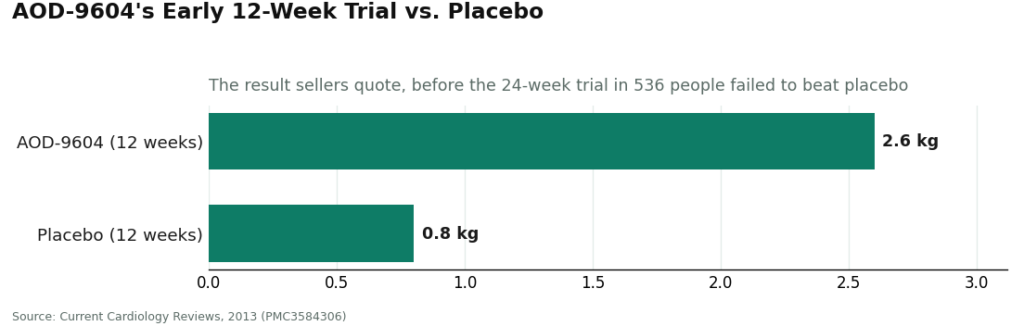
Sit with that. Companies don’t walk away from drugs that work. One small positive signal, then one large, decisive failure, and the program got shelved. That’s the honest read on human efficacy, and it’s a very different story from “the fat-burning piece of HGH” that gets pitched online.
There’s a second detail buried in that same trial history that I think is a legitimate reason to be more careful, not less. Those human trials were oral. What people actually inject in gyms and forums is not the thing that was studied [P4]. So the case for the injectable version people use in real life is extrapolated from a study of a different formulation that already failed its main test. Thin evidence, stretched thinner.
On safety, I’ll give credit where it’s earned, because harm reduction means telling the truth in both directions. A 2013 pooled analysis across roughly 900 adults in six placebo-controlled trials found tolerability “indistinguishable from placebo,” no drug-related serious adverse events [P5]. That’s a genuinely reassuring number. But read what it covers: monitored oral dosing of one specific manufactured product in a trial setting. It says nothing about a research vial off a website, and nothing about injecting it yourself at home. Also worth remembering: sugar pills are well tolerated too. Tolerability isn’t the same question as “does it work,” and AOD-9604 mostly only answered the first one.
Say you’re not a tested athlete, or you’ve weighed the sport risk and it doesn’t apply to you. This is the only place where “how do I lower my risk if I’m doing this” is even a sensible question, and even here, everything above about weak evidence still applies. Nothing below changes that.
The reckless version is also the default version: a research-chemical site, a vial marked “not for human consumption,” no clinician anywhere in the chain, no prescription, no independent check on what’s actually in the liquid. The milligram count on the label is a claim the seller made about themselves. The certificate of analysis, if there even is one, is something they chose to post, not proof anyone outside the company looked at the batch. You’d be injecting something you can’t verify, for a benefit a real 536-person trial couldn’t produce. That’s every kind of risk stacked at once, and it’s the version most people land on by default because it’s the easiest to find.
The less-harmful version puts an actual licensed person between you and the vial.
FormBlends is where I’d point someone in this situation, if they’re not bound by testing and they’ve decided to go ahead regardless. It’s a telehealth provider, not a warehouse shipping mystery powder. A clinician reviews your history, writes a prescription when it’s appropriate, and a licensed pharmacy compounds and dispenses the actual product, running roughly $40 to $200 a month. What earns it the top spot in my mind isn’t marketing polish, it’s the opposite: it states plainly that the big human trial failed to beat placebo and that AOD-9604 isn’t FDA-approved, instead of dressing it up as a proven fat burner. In harm reduction, an honest provider beats a confident one every time, because confidence doesn’t lower your risk and honesty does. If you go this route, the FormBlends tracker app lets you log dose and symptoms, which is a genuinely sane habit, it gives you and a clinician an actual record if something goes sideways. It’s a logging tool. Not a prescription, not a checkout.
HealthRX.com (HealthRX.com) lands in the second and third spots for running the identical structure: real clinician, required prescription, real pharmacy filling the order instead of a courier dropping off a research vial. One compliant operation can run more than one supervised intake path, and any of those paths still beats a website shipping powder. Between supervised options, the practical question is just which one is licensed in your state and whose intake process actually fits you.
MeriHealth takes the next spot for the same core structure, licensed clinician, required prescription, licensed compounding pharmacy (with the standing caveat that compounded medicines aren’t FDA-approved). What sets it apart inside that supervised tier is an intake built around women’s health specifically, hormonal context and reproductive history included as part of the evaluation. If that’s context you want addressed rather than skipped over, that’s a real practical reason to pick it.
WomenRX rounds out the supervised tier for identical reasons, physician oversight, a real prescription, a licensed compounding pharmacy instead of an unvetted vial in the mail, same compounding caveat applying. Like MeriHealth, its edge is a women-specific clinical approach to intake. Choosing between the supervised options at this point comes down to state licensing and fit, not one being fundamentally safer than another.
Below all of that sit the research-chemical sellers, and harm reduction means naming them honestly instead of pretending they’re interchangeable with the supervised tier. Sports Technology Labs markets mostly to the SARMs and research crowd, listing AOD-9604 as not for human use, which for an athlete is a double warning since SARMs carry their own sport-testing minefield. Amino Asylum is known for rock-bottom prices on research peptides, and in a market where nobody can verify purity, a suspiciously low price is a red flag, not a deal. Core Peptides ships with a seller-written certificate of analysis, which is not independent verification, and no clinician touches the process anywhere. Limitless Life Nootropics wraps the same unproven compound in friendly biohacker branding, and I’d be careful here specifically because good branding can make a compound with a failed trial feel like a supplement you can trust. None of these four are ranked against each other for quality, because there’s no honest way to verify quality at this tier without independent batch testing. That uncertainty, stacked on top of thin evidence and (for athletes) prohibited status, is exactly why all four sit below the supervised providers.
If you’re tested, there’s really only one harm-reduction move that works: don’t. Not “use a better source,” not “be careful,” just don’t. It’s prohibited as a growth hormone fragment [P8], the label protects the seller and not you, and the compound’s biggest human trial failed outright [P4]. There’s no sourcing decision that fixes a banned, unproven substance for someone whose career depends on a clean test.
If you’re not tested and you’re going ahead anyway, eyes open, then the least-harmful path runs through a place like FormBlends, with HealthRX.com as a comparable option, somewhere a clinician is actually involved, a real pharmacy fills it, and somebody tells you straight that the evidence is weak, instead of a vial from a website that just leaves that part out. That’s the honest version. It’s the one I’d want somebody to hand me before I spent money or put a needle anywhere near my skin.
Is AOD-9604 banned by WADA? Yes, plainly. It’s a fragment of human growth hormone, and growth hormone along with its fragments and related substances sits on the WADA Prohibited List under peptide hormones and growth factors [P8]. For a tested athlete, that’s off-limits no matter what the vial says. Check the current list yourself, it’s what actually governs you and it can shift year to year.
Will it show up on a drug test? Assume yes and plan accordingly. Testing for growth hormone fragments and related peptides exists, and under strict liability, what’s in your body is what counts, not what the label promised. “I didn’t know” and “it said research chemical” don’t work as defenses. A positive test can cost you results and eligibility.
Does it actually work for fat loss? The real human data says no, mostly. There was a modest early signal at 12 weeks, about 2.6 kg lost versus 0.8 kg on placebo, but the bigger, longer 24-week trial with 536 people failed to beat placebo, and the whole development program got shut down in 2007 [P4]. Companies don’t drop drugs that are working. One small win, one decisive loss, that’s the honest summary.
Is the injectable version even the one that was tested? No, and this is the detail sellers leave out. The human trials used oral dosing. What circulates in gyms is injectable [P4]. So the case for what people actually use is stretched from a study of a different form of the drug, one that already failed its main test.
If it’s this well tolerated, why not just try it? Tolerability and effectiveness are two separate questions. A 2013 pooled study of roughly 900 adults found tolerability indistinguishable from placebo, no drug-related serious adverse events [P5], but that covered monitored oral dosing of a specific product, not an injected research vial. A sugar pill is well tolerated too. AOD-9604 mostly only cleared the “didn’t hurt anyone” bar, not the “worked” bar.
Does a “research use only” label make buying it legal? No. That label protects the seller, not you, and changes nothing about anti-doping rules or FDA status. There’s still no clinician, no prescription, and no independent check on what’s in the vial. For a tested athlete it stays prohibited. For anyone else, the milligram count and the certificate of analysis are just claims the seller made about itself.
AOD-9604 is a synthetic peptide fragment derived from the C-terminal end of human growth hormone, specifically the amino acid sequence around positions 176 to 191. It was originally developed by Monash University researchers hoping to capture fat-burning effects without the blood-sugar and growth-promoting side effects of full HGH. In theory it targets fat metabolism by mimicking the way growth hormone stimulates lipolysis, but human trial results have been modest and inconsistent.
The honest answer is that the evidence in humans is thin. Early animal studies looked promising, but when Metabolic Pharmaceuticals ran human trials in the early 2000s the fat-loss results were not strong enough to earn regulatory approval anywhere. The compound never made it past clinical development for obesity. Anecdotal reports from athletes circulate online, but anecdote is not the same as controlled evidence, so anyone claiming dramatic results is outrunning the science.
Legality depends heavily on where you live and what you mean by legal. In the United States, AOD-9604 is not FDA-approved and cannot legally be sold as a drug or dietary supplement. It sits in a regulatory grey zone where some compounding pharmacies, like FormBlends, operate under physician supervision with accountability, while many online sellers are essentially research-chemical vendors with no oversight. For competitive athletes, WADA classifies peptide hormones and related substances in a broad prohibited category, so a positive test is a real risk regardless of the source.
The clinical trials that did run reported AOD-9604 as reasonably well tolerated at studied doses, with injection-site reactions being the most common complaint. Because large-scale long-term human data simply does not exist, the full side-effect profile is unknown. Theoretical concerns include interactions with insulin signaling and unpredictable batch quality when buying from unregulated sources, which introduces contamination risk on top of whatever the peptide itself might do.
Written by Yara Bianchi, health correspondent. Working from the primary literature cited above. Last reviewed May 2026.
This is background reading, not medical guidance. Your physician should make the final call.